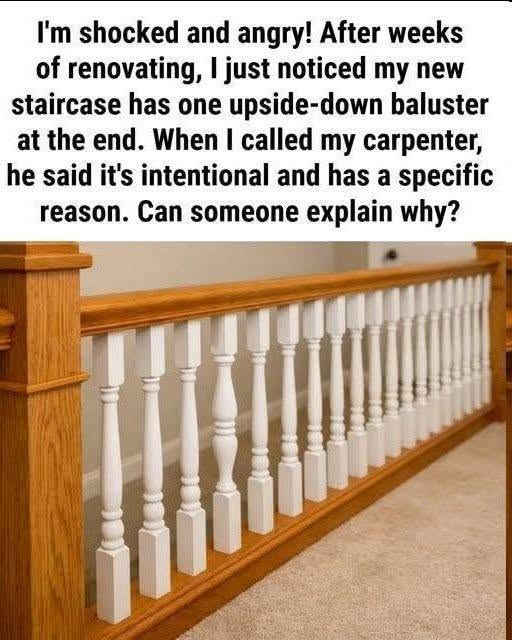
Could an Upside-Down Baluster Be Intentional?
Sometimes, yes.
A decorative baluster may have been deliberately positioned differently to fit the overall design, accommodate a particular section of the staircase, or solve an installation problem.
In historic homes, staircases were often made and assembled by hand rather than produced from perfectly standardized components.
That means small variations aren’t necessarily evidence of an error.
The Folklore Behind Upside-Down Details
Here’s where things get especially interesting!
You may have heard the old idea that one intentionally reversed or upside-down element was placed in a house to remind people that only God is perfect.
This story is often associated with traditional craftsmanship and decorative imperfections in older buildings.
The idea is charming: a craftsman supposedly included one deliberate imperfection as a reminder of human limitations.
However, it’s important to distinguish folklore from documented historical fact.
There isn’t a universal historical rule saying that every upside-down baluster was deliberately installed for this reason.
In many cases, an upside-down baluster is much more likely to be the result of an ordinary construction, repair, or installation decision.
Still, the tradition makes these little imperfections fun to discover—and gives an old house an extra bit of personality.
Does One Upside-Down Baluster Mean the House Is Old?
Not necessarily.
An unusual baluster can certainly be found in an older home, but the detail alone isn’t enough to determine a property’s age.
Other clues are much more useful when you’re trying to understand a home’s history.
Look at:
The staircase construction
Original flooring
Doors and trim
Window styles
Hardware
Fireplace design
Foundation materials
Roof construction
Electrical and plumbing systems
Original architectural details
A combination of these features can provide a much better indication of when a home was built or remodeled.
Why Old Houses Have So Many Little Imperfections
One of the things I love most about older homes is that they often aren’t perfectly symmetrical.
You may find:
A crooked doorway
Slightly uneven floors
Different-sized windows
Hand-cut trim
A stair tread that isn’t perfectly identical to the others
An unusual piece of molding
One baluster that doesn’t quite match
Modern construction tends to emphasize uniformity and precision.
Older homes often tell a different story.
Many were constructed by people working with hand tools, locally sourced materials, and techniques that allowed for small variations. Those imperfections can actually be part of what makes an old house so charming.
Is an Upside-Down Baluster a Structural Problem?
Usually, the orientation of a decorative baluster by itself isn’t a structural concern.
What matters more is whether the baluster is securely attached and functioning properly as part of the railing system.
If you notice that the baluster is loose, cracked, damaged, or unable to support the handrail correctly, that’s a different issue.
A staircase should be inspected and repaired if any part of the railing feels unstable.
When Should You Have It Checked?
Consider having a professional look at the staircase if:
The baluster moves when touched
The handrail is loose
Wood is cracked or rotting
Fasteners are missing
Several balusters are damaged
The railing doesn’t feel secure
The staircase has recently been altered
The visual oddity is usually less important than the structural condition.
Should You Turn It Right-Side Up?
If you’ve discovered an upside-down baluster in your home, you might be tempted to fix it immediately.
But before grabbing your tools, take a moment to consider its history.
If the staircase is old or historically significant, changing original components could remove part of its character.
If the baluster was installed incorrectly during a recent renovation, correcting it may make sense.
And if you’re simply unsure, a carpenter or historic-home specialist can help determine whether the piece is original and whether changing it would affect anything.
Sometimes leaving a harmless imperfection alone is the better choice.
What If There Is Only One?
For Complete Cooking STEPS Please Head On Over To Next Page Or Open button (>)